

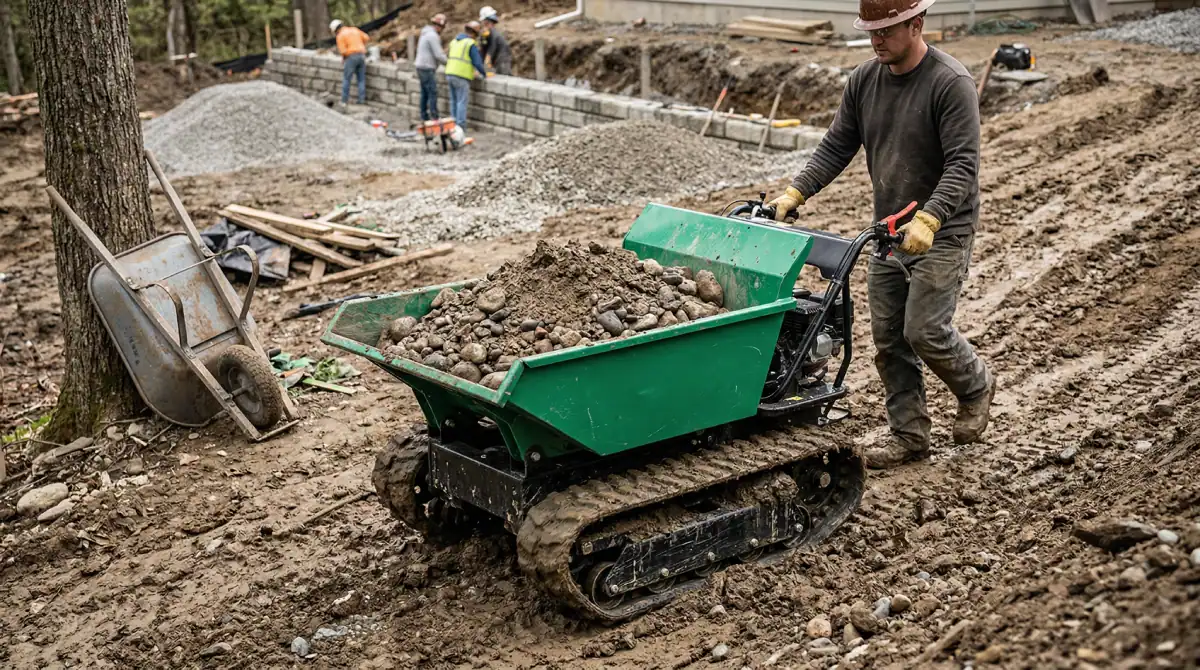
If you have ever spent a long weekend hauling dirt, gravel, concrete, or firewood up a hill using a standard manual wheelbarrow, you already know the toll it takes on your back and shoulders. While traditional wheelbarrows are essential tools for any job site or large property, they have strict limitations based on human strength. When the job gets too big, it is time to upgrade to a large motorized wheelbarrow.
Also known as power wheelbarrows or motorized dump carts, these heavy-duty machines take the physical strain out of landscaping, construction, and farming. They allow you to move massive payloads over rough terrain with the simple push of a throttle.
Whether you are a professional contractor looking to speed up site prep, or a homeowner managing a sprawling, hilly property, this guide will walk you through everything you need to know about buying and using a large motorized wheelbarrow.
Why Upgrade to a Large Motorized Wheelbarrow?
The decision to transition from manual labor to motorized equipment usually comes down to three factors: time, safety, and physical capability.
- Massive Payload Capacity: A standard wheelbarrow maxes out at whatever the user can safely lift and push—usually around 150 to 200 pounds before it becomes dangerously unstable. A large motorized wheelbarrow can easily handle anywhere from 500 to over 1,000 pounds of material in a single trip.
- Reduced Physical Strain: Workplace injuries and chronic back pain are incredibly common in construction and landscaping. By relying on a motor to do the heavy lifting and pushing, you protect your body from repetitive strain injuries.
- Conquering Terrain: Pushing a heavy load up an incline or through thick mud is nearly impossible manually. Motorized units are designed with aggressive traction, allowing them to power through mud, snow, loose dirt, and steep grades without missing a beat.
- Increased Productivity: Because you can move three to five times the amount of material per trip without getting exhausted, your project timelines are drastically reduced.
Key Features to Consider Before You Buy
Not all power barrows are built the same. Because this is a significant investment, you need to match the machine’s specifications to your specific workload.
1. Tracks vs. Wheels
This is the most critical decision you will make when shopping for a motorized wheelbarrow.
- Wheeled Models: These typically feature four wheels, often with agricultural-style deep treads. They are faster, easier to maneuver in tight spaces, and generally less expensive. They are best for relatively flat ground, solid turf, and hardscapes.
- Tracked Models: Tracked (or crawler) dumpers use continuous rubber tracks similar to a mini-excavator. These distribute the weight of the machine over a larger surface area. If you are dealing with deep mud, very steep hills, or soft, delicate turf that you don’t want to tear up with heavy tires, a large tracked motorized wheelbarrow is the superior choice.
2. Gas vs. Electric Power
- Gas-Powered: For maximum power, heavy commercial use, and remote job sites without access to electricity, gas-powered engines (typically ranging from 5.5 to 9 horsepower) are the industry standard. They offer relentless torque for moving heavy loads up steep hills.
- Battery-Powered (Electric): Electric motorized wheelbarrows are rapidly gaining popularity. They operate silently, produce zero zero emissions (making them safe for indoor demolition or barn use), and require zero engine maintenance. High-end lithium-ion models now offer run times that can last an entire workday on a single charge.
3. Hopper Capacity and Material
Look closely at both the volume (cubic feet) and the weight capacity (pounds). For a “large” model, you should be looking for a minimum weight capacity of 600 pounds. Additionally, consider the hopper material. Steel hoppers are incredibly durable and best for hauling sharp rocks, broken concrete, or heavy tools. High-density poly (plastic) hoppers are lighter, will never rust, and are excellent for mixing concrete, moving wet soil, or hauling animal feed.
4. Dumping Mechanism
Loading the material is only half the battle; you also have to unload it.
- Manual Dump: The hopper is balanced on a pivot. You release a latch and manually tip the bucket forward. Because of the pivot point, it requires very little physical effort, even when fully loaded.
- Hydraulic Dump: Found on the largest, commercial-grade models, a hydraulic lift tilts the hopper at the push of a button. This is ideal for loads exceeding 800 pounds.
Popular Products on the Market
When browsing for a large motorized wheelbarrow, you will likely come across a few distinct categories of popular products that dominate the market.
The Heavy-Duty Tracked Dumper Brands like Yardmax and Canycom produce heavy-duty gas-powered tracked dumpers that are favorites among hardscapers and contractors. These units often feature multi-speed transmissions (with reverse) and solid steel hoppers capable of carrying upwards of 1,000 lbs. They are the ultimate off-road hauling machines.
The High-Capacity Electric Wheelbarrow For those already invested in a battery ecosystem, tool brands like Makita offer impressive brushless cordless power-assisted wheelbarrows. These often feature an interchangeable steel bucket or tubular steel frame. They are highly valued for their quiet operation and zero-emissions output, making them perfect for residential landscaping early in the morning.
The All-Terrain Wheeled Power Cart Brands such as SuperHandy and Landworks manufacture excellent four-wheeled electric and gas carts. These look more like traditional wagons but feature deep-tread pneumatic tires and powerful drive systems. They are slightly more affordable and are incredibly popular among homesteaders, farmers, and equestrians for daily chores.
Frequently Asked Questions (People Also Ask)
How much weight can a large motorized wheelbarrow hold? While small, entry-level power carts might hold 300 pounds, a true large motorized wheelbarrow can hold between 600 and 1,100 pounds. Heavy-duty commercial tracked dumpers can sometimes hold up to 1,500 pounds of material.
Are motorized wheelbarrows worth the money? If you regularly move heavy materials like stone, wet dirt, gravel, or firewood—especially over uneven terrain or inclines—they are absolutely worth the investment. They pay for themselves quickly by saving time, reducing the need to hire extra laborers, and preventing costly back injuries.
How fast do motorized wheelbarrows go? Most models are designed to move at a comfortable walking pace to ensure the operator remains in control safely. You can expect forward speeds ranging from 2.5 to 4.5 mph, with reverse speeds generally capped around 1.5 to 2 mph.
Can a motorized wheelbarrow go up hills? Yes, conquering inclines is one of their primary benefits. A standard wheeled motorized wheelbarrow can usually handle inclines up to 15 or 20 degrees, while aggressive tracked models can safely navigate slopes of up to 25 to 30 degrees, depending on the payload and ground conditions.
Final Thoughts
Investing in a large motorized wheelbarrow changes the way you approach outdoor projects. By taking the heavy lifting out of the equation, you can focus on the actual work of building, planting, or renovating without exhausting yourself before noon. Whether you opt for a silent electric wheeled cart for your homestead or a rugged, gas-powered tracked dumper for your contracting business, upgrading your hauling equipment is a decision your back will thank you for.


